
The Picasso Problem: Why the Future of Investing Looks Abstract, with Bitcoin as the Epilogue

Introduction: A Dot That Finally
Connected
This week I listened to a Tim
Ferriss interview with Bill Gurley. Gurley has long been one of my favorite
thinkers, in part because of his connection to the Santa Fe Institute. The
Santa Fe Institute is a pioneering research center focused on understanding
complex adaptive systems, and Gurley serves as a trustee, reflecting his belief
that markets, technology, and investing are best understood through the lens of
complexity science.
When I’m looking for deeper
answers, I’ll often reframe a question to an LLM using this same Santa Fe
Institute lens, modeling the system rather than the headline, and tracing
second and third order effects. In this interview, Gurley made an observation that
stayed with me longer than most market commentary as I was riding the subway.
He referenced Pablo Picasso, not
the abstract revolutionary we remember, but the young realist. Picasso, Gurley
noted, was technically brilliant long before Cubism. He could paint reality as
well as anyone alive. His move toward abstraction wasn’t a rejection of skill;
it was a recognition that realism had stopped being the frontier.
That comment connected a dot for me.
Because the same tension now exists
in investing.
Picasso and the End of Realism as an Edge
Picasso’s early realism proved
mastery. But mastery of realism became less valuable once photography emerged.
Reality could be captured faster, cheaper, and more accurately by machines.
So Picasso moved on, not because
realism was wrong, but because it was finished.
Abstraction allowed him to show
multiple perspectives at once. It was harder to understand, easier to dismiss,
and impossible to value using traditional criteria. But it was also the future.
Gurley’s point wasn’t really about
art. It was about phase transitions.
When the tools of realism become
commoditized, the advantage shifts to interpretation.
That is exactly where investing is
today.
Daniel Pink, Revisited Through an AI Lens
I often reference Daniel Pink’s A Whole New Mind because it captured something fundamental: the world was moving from
left-brain dominance, logic, analysis, optimization, toward right-brain
capabilities like synthesis, pattern recognition, and meaning.
What struck me recently is how
completely AI finishes Pink’s argument rather than contradicts it.
AI doesn’t just assist analytical
work.
It eliminates its scarcity. Forecasting, modeling,
optimization, once the domain of elite human cognition, are now automated,
scalable, and increasingly cheap. The value of being precisely right about the
present is collapsing.
What remains scarce is not accuracy.
It’s perspective.
Pink anticipated a conceptual age.
AI accelerates us into something more extreme: an abstract age, where meaning
arrives before measurement and structure emerges before labels.
The Market’s Mistake About AI
Bill Gurley made another
observation in that interview that matters here:
“The institutional investors have zero interest in non‑AI deals. Zero.”
That tells us something important.
The market believes AI is the new
realism, the obvious, necessary investment. Infrastructure, models, compute,
applications. Capital feels comfortable here because these things can still be
modeled, benchmarked, and justified.
I don’t believe AI is a bubble.
But I do believe the market is
confusing where money is going with where understanding ends.
AI may be the new realism.
But the future created by AI is abstract.
That distinction matters.
Investing in a World That Is No Longer Legible
Realist investing assumes:
· Stable categories
· Linear progress
· Measurable adoption
· Clear valuation anchors
AI breaks those assumptions.
As AI reshapes labor, productivity,
creativity, and coordination, outcomes become harder to forecast and easier to
misinterpret. Value migrates faster than accounting systems can track it.
Confidence decays even as capability explodes.
Companies no longer fit stable
categories. Tesla isn’t a car company or a tech company, it’s both and neither.
Oracle carries massive remaining performance obligations from AI infrastructure
deals, yet faces real execution risk if monetization lags or if debt matures
before backlog converts to cash flow.
The uncertainty isn’t about whether
opportunity exists, it’s about whether traditional frameworks can time it.
This is not a world that rewards
better spreadsheets.
It rewards those who can hold
ambiguity without demanding premature clarity.
Just as Cubism looked chaotic
before it looked obvious, abstraction in investing appears irrational before it
becomes self-evident.
From Realism to Abstraction,
Personally
Tracing this arc from Picasso, to
Pink, to Gurley’s observations on AI capital flows, clarified something for me.
The shift we are living through is
not simply technological.
It is
epistemological.
It’s about how we know what we know.
We are moving from a world where
realism worked to one where abstraction is required, not because it is elegant,
but because reality itself has become multi-dimensional and unstable.
This is not an argument against
investing in AI infrastructure. Infrastructure is always a means, not an end.
The question is not whether AI matters; it does.
The question is: what investment framework survives in the world AI
creates?
That realization eventually brought
me to Bitcoin.
Epilogue: Bitcoin
Bitcoin is abstract.
It has no cash flows.
No
issuer.
No
traditional valuation framework.
No
single function.
And that is precisely why it
persists.
Bitcoin does not resolve
uncertainty, it absorbs it. It exists
as a constrained, neutral system in a world where trust, measurement, and
control are increasingly fragile under the weight of AI-driven change.
Bitcoin is not the answer to AI.
It is the companion to the
uncertainty AI introduces.
In that sense, Bitcoin is not the
subject of the painting.
It is the detail that only becomes
visible once realism has failed and abstraction becomes necessary.
By the time investors recognize
this, perhaps in hindsight, perhaps around 2026, the question won’t be whether
Bitcoin made sense.
It will be whether we were asking
it to make sense too early, using the wrong lens.
Realism didn’t disappear.
It just stopped being enough.
And abstraction, first dismissed,
then tolerated, quietly became essential.
Now I want to thank you all for
spending part of your year with me and for sharing this Substack with others.
Writing here has been a grounding force for me, and I hope these pieces have
sparked reflection and offered some steadiness in a world that often feels
increasingly uncertain.
Beginning next year, I’ll be
starting a second Substack focused on something deeply personal: my journey to
improving heart rate variability (HRV), and what it has taught me about
learning, anxiety, health, and happiness in an age of exponential change. I’ve
come to see this journey as important not just for me, but for my children as
well as part of the example and guidance we all try to set while helping them
grow up in a world that is changing faster than any generation before them.
Think of it as a book written one chapter at a time, with each week reflecting
something I learned over a five-year process of trial, error, and gradual
understanding. This is my message to all books in the future to not be repetitive with the same message every chapter but a journey where you can double click to understand and use the information.
At the end of each post, I’ll
include a simple prompt so you can explore the ideas further in your own way,
often using systems-thinking approaches like the Santa Fe Institute lens I
mentioned earlier. This will be done in a way that I guarantee will help
you on your journey of incorporating AI into your life and your whole family.
What this journey has taught me is
that HRV isn’t something you “optimize” through a Type-A mindset or harder
workouts alone. It improves through balance both through health, internal and
external but also in your relationship with nature and technology which works
against each other.. And that lesson applies far beyond health to how we work,
how we show up in relationships, and how we pursue a more grounded sense of
happiness.
I’m grateful you’re here, and I’m
excited to share this next chapter with you and, ultimately, with the next
generation as well.
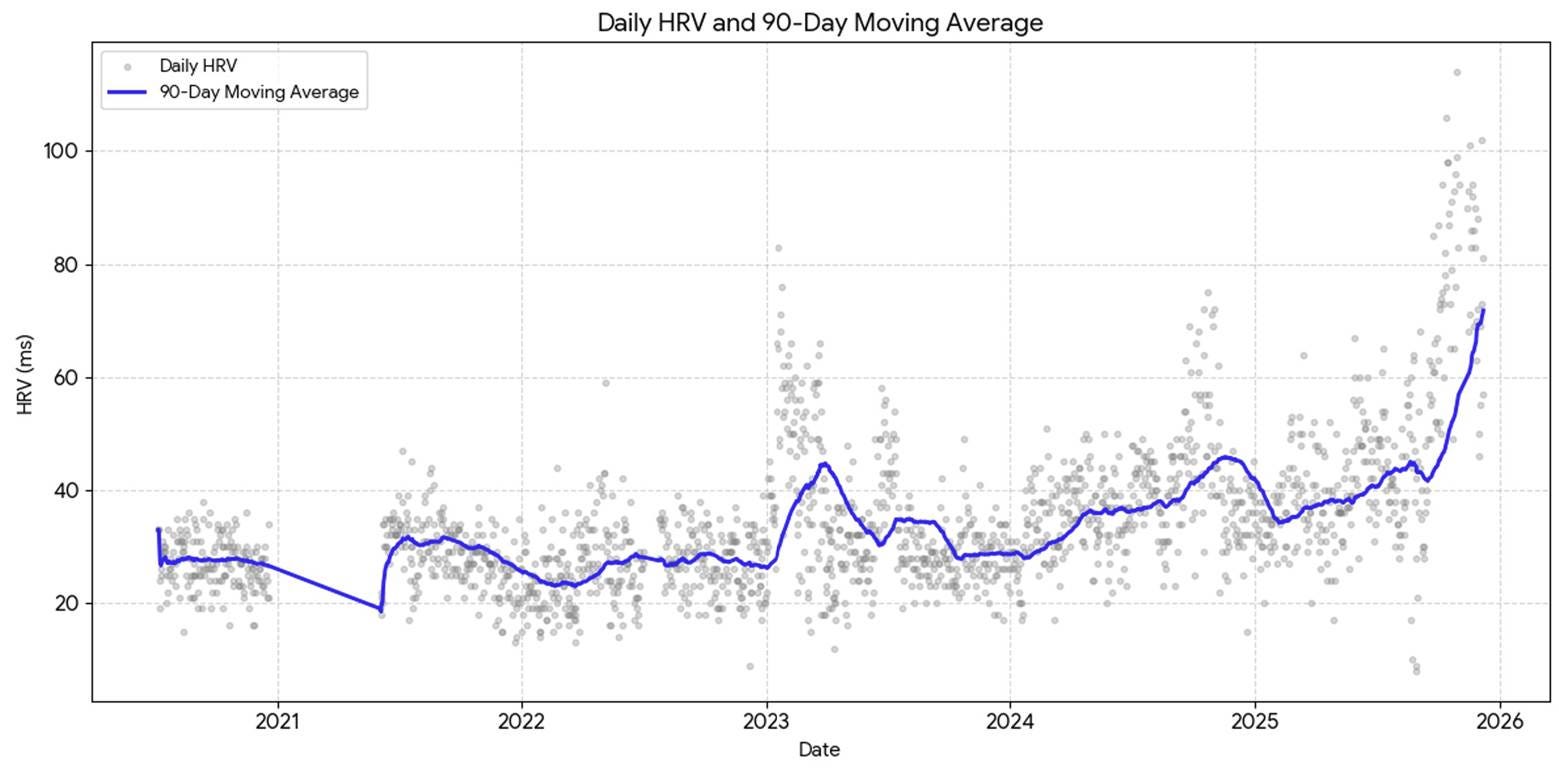
This chart of my five year journey
isn’t about optimization or shortcuts, it’s a quiet record of what balance
looks like over time.
Wishing you
and your family a peaceful, healthy holiday season and a hopeful start to the
year ahead.
Jordi, your work both on Substack and on YouTube videos is much anticipated by me, and apparently by so many others.
Thank you for your work and insights over the past year. All the best to you and your family in this holiday season and in 2026.
FWIW I’m a senior citizen, BtC MSTR hodler.
I have an M.Sc in economics from the LSE and gave it up over 50 years ago (yikes!!!) because it was too boring to consider as a lifelong profession—writing meaningless papers, and watching the 1971 gold rug pull by Nixon along with the inevitable dollar debasement to further enrich the already rich without any remedy then in sight.
I have been encouraged to see so many new, younger voices explaining and opening this new world that bitcoin and AI are presenting to all of us.
Thanks again. Alan
Always thrilled with your commentary on the markets and beyond. Looking forward to hearing more about your own personal journey with HRV. Happy holidays! May your stocking be full of bitcoin 🎄