

Affordability: When the System Stops Delivering
Affordability has become one of the defining economic and political issues of our time. In the United States and increasingly throughout Europe, households are questioning whether the economic system is delivering the prosperity they were promised. Inflation, housing costs, interest rates, and income growth dominate the discussion, but I believe affordability represents something much more fundamental.
Affordability is the relationship between an individual’s present circumstances and their expectations for the future. It encompasses income, purchasing power, borrowing costs, job security, career advancement, and the ability to accumulate wealth. For generations, people accepted financial sacrifices because they believed education, hard work, and career progression would eventually allow them to improve their standard of living.
That belief is increasingly under pressure. A household can experience lower inflation and still struggle to afford a home. Someone can earn a higher salary while watching asset prices appreciate even faster. An employee can have a well-paying job today but question whether the traditional corporate ladder will exist tomorrow.
Affordability is ultimately about the ability to participate in economic progress. When people lose confidence in that pathway, they begin questioning whether the economic system itself is working.
This brings us to a monetary argument that Jeff Booth made years before artificial intelligence began transforming the global economy.
Jeff Booth, Bitcoin, and the Contradiction at the Heart of Money
In his 2020 book The Price of Tomorrow, Jeff Booth argued that technological innovation is naturally deflationary. Technology allows society to produce more output with fewer resources, reducing the cost of goods and services as productivity improvements spread through competition.
But our financial system operates on a different foundation. Governments, corporations, and households have accumulated enormous nominal debt obligations that become more difficult to service when broad deflation reduces incomes and revenues. This creates a powerful incentive for policymakers to sustain nominal growth through credit expansion, fiscal spending, and monetary intervention.
Booth’s central insight was that the benefits of technological deflation can become distorted by a debt-backed monetary system that continually requires economic expansion. Monetary accommodation can support asset prices, benefiting people who already own capital, while households dependent primarily on labor income may struggle to accumulate those same assets.
This is where Bitcoin enters the argument. Launched in the aftermath of the global financial crisis, Bitcoin introduced a monetary asset with a predetermined issuance schedule and a maximum supply of 21 million coins under its established consensus rules. Its supply does not expand in response to government financing requirements.
For Booth, Bitcoin represents a monetary alternative through which technological progress and monetary scarcity can coexist. Its fixed issuance schedule provides a contrast to a financial system whose ability to manage debt often depends on monetary flexibility.
I believe artificial intelligence is now accelerating the contradiction Booth identified. And two developments in October 2026 illustrate different dimensions of the problem.
France: The Affordability of the Present
France provides a compelling example of how affordability has become a broader question about economic participation and wealth distribution.
An October 2026 Sciences Po CEVIPOF survey found that 45% of French respondents identified inflation and purchasing power as a major concern. More revealing was the difference between households based on accumulated wealth. Among respondents without wealth, 58% identified living costs as a concern, compared with 33% of those with more than €300,000 in assets.
The same economy produces dramatically different experiences depending on whether a household owns productive assets or relies primarily on income from labor. Asset ownership provides participation in wealth creation, while nonowners face the challenge of accumulating savings fast enough to purchase assets whose prices may continue rising.
France also illustrates the government’s difficulty in responding. Public debt reached 119% of GDP in the second quarter of 2026, leaving policymakers facing substantial financing obligations while households demand relief from living costs.
This is the affordability problem as it exists today. But artificial intelligence introduces another dimension: the possibility that the traditional pathway from labor income to wealth accumulation becomes less predictable.
Microsoft may be providing an early illustration of what that future looks like.
Microsoft: The Affordability of the Future
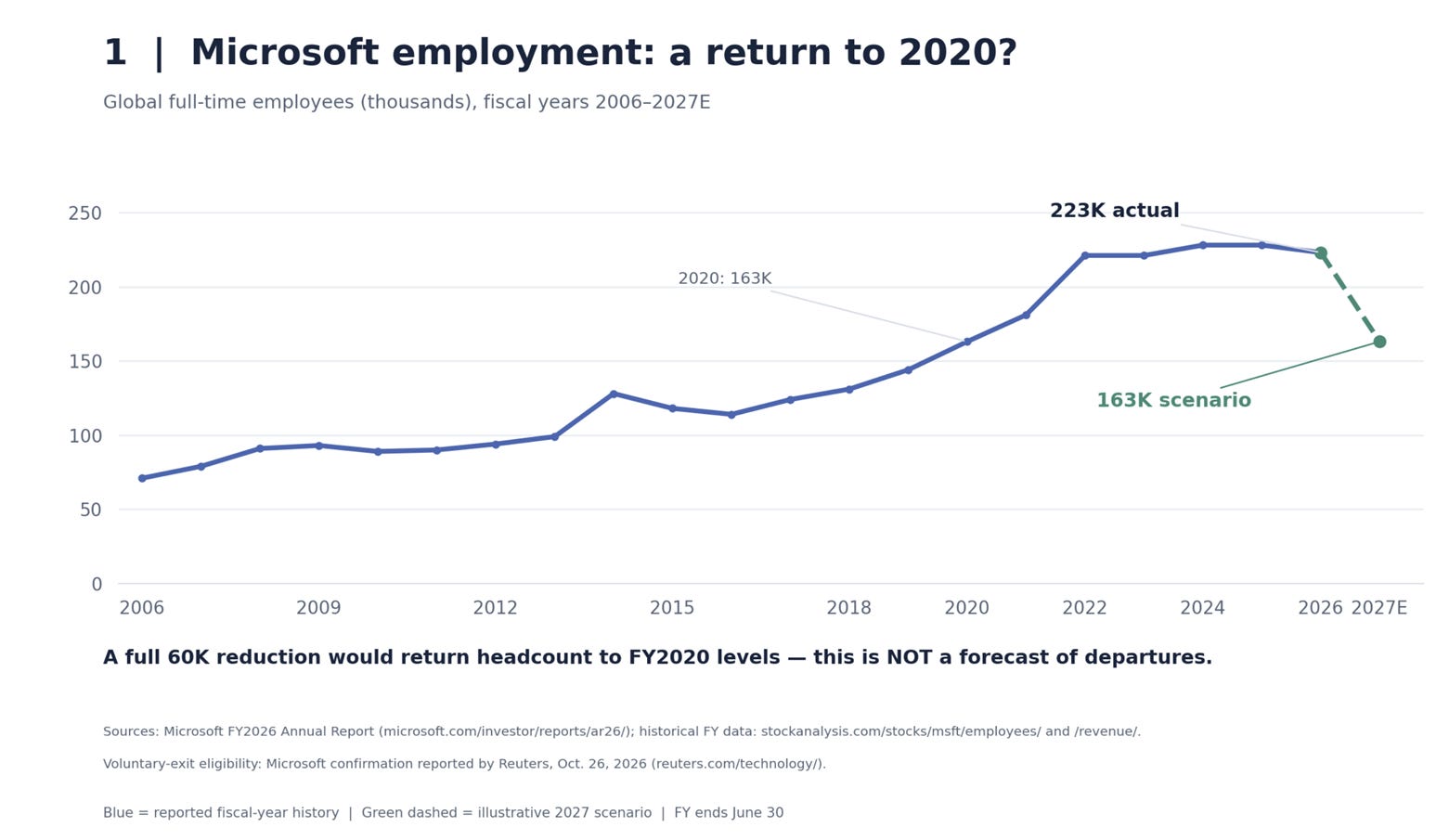
On October 26, Microsoft announced voluntary exit packages for approximately 60,000 employees, representing 27% of its global workforce. The remarkable aspect of this announcement is the company’s financial performance.
Microsoft generated approximately $332 billion in fiscal 2026 revenue, an increase of 18%. Operating income increased 21%, while Azure revenue grew 41%. The company is experiencing extraordinary growth while investing enormous amounts of capital in artificial intelligence infrastructure.
The offer does not represent 60,000 confirmed departures, and actual participation may be substantially smaller. Nevertheless, examining a hypothetical full reduction illustrates how dramatically the economics of labor and capital could change.
In 2006, Microsoft employed approximately 71,000 people and generated $44 billion in revenue. By 2026, employment had increased to 223,000, while revenue reached $332 billion.
Now consider the hypothetical scenario in which all 60,000 eligible employees departed and were not replaced. Microsoft’s workforce would decline to approximately 163,000 employees, returning to its 2020 level. Under our illustrative fiscal 2027 revenue assumption of $391 billion, the company would generate nearly three times its 2020 revenue with approximately the same number of employees.
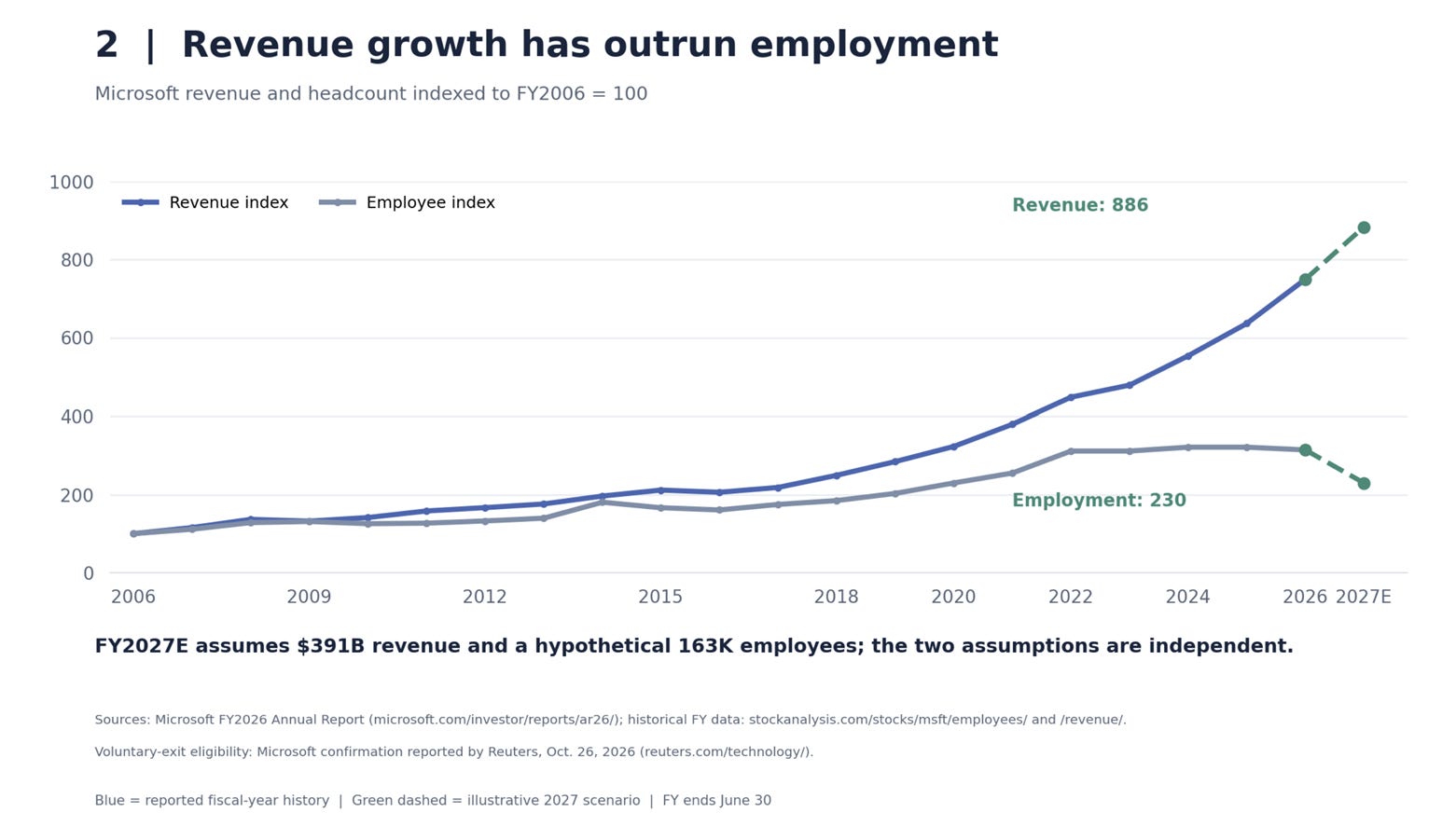
The divergence between revenue growth and employment growth becomes particularly striking when both are indexed to 2006.
Revenue per employee provides another perspective. In 2006, Microsoft generated approximately $625,000 per employee. By 2026, that figure had increased to nearly $1.5 million. Under the hypothetical 2027 scenario, it would approach $2.4 million.
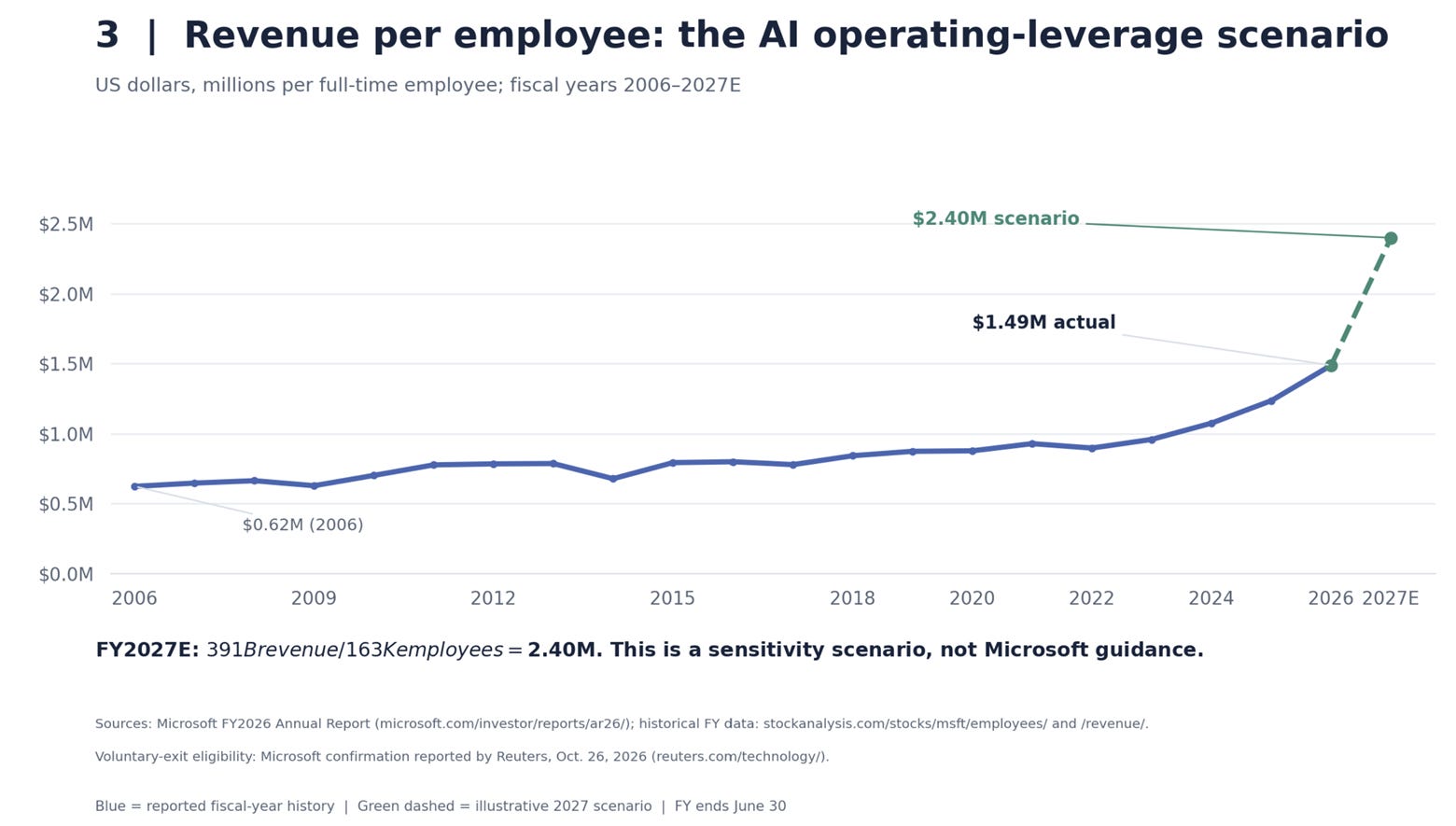
Revenue per employee is influenced by factors beyond labor productivity, including pricing, outsourcing, acquisitions, and business mix. Still, these figures illustrate an important potential transition: corporations may increasingly generate higher revenues without proportionately expanding their workforces.
AI allows productive capital to perform a growing number of tasks historically dependent on human intelligence. Compute, software, and autonomous agents can increasingly complement or substitute for certain forms of labor, potentially changing the relationship between employment and corporate growth.
For shareholders, this can create extraordinary operating leverage. For workers, it raises questions about future income, career progression, and access to the wealth being created.
When Capital Succeeds and Labor Needs Support
Historically, large employment reductions have often accompanied corporate weakness. Revenues decline, profitability deteriorates, investment slows, and unemployment rises. Governments respond through unemployment benefits, fiscal support, and monetary easing as economic demand weakens.
AI introduces the possibility of a different cycle. Corporations may experience rising revenues, expanding profits, and improving productivity while reducing their dependence on human labor. The owners of capital benefit from higher returns, while workers whose tasks are displaced may require time and support to adapt.
The implications extend beyond immediate unemployment. If corporate hierarchies become smaller and more automated, employees may question their future earnings potential. The expectation of career advancement has historically helped households justify borrowing, purchasing homes, and making long-term financial commitments.
Governments may therefore face growing pressure to support labor even while the corporate sector remains exceptionally profitable. Retraining, unemployment assistance, healthcare support, and broader income transfers could become increasingly important during the transition.
In previous economic cycles, governments often supported labor because capital was struggling. In the AI cycle, governments may have to support labor precisely because capital is succeeding.
That creates an unusual macroeconomic problem. Private-sector investment may remain exceptionally strong at the same time that governments face additional social obligations.
The government must finance the adjustment while corporations are competing aggressively for the capital required to accelerate it.
The Price of Building Abundance
I have described artificial intelligence as QE for the Mind because it expands the productive supply of intelligence. Research, software development, analysis, and increasingly complex business processes can be completed with fewer resources and in less time.
This should create enormous long-term productivity gains. But the physical infrastructure required to deliver AI is extraordinarily capital intensive. Semiconductors, data centers, electricity, transformers, networking equipment, cooling systems, and construction all require substantial investment.
This produces an important paradox.
AI is deflationary in the intelligence it produces, while its deployment can create inflationary pressures through extraordinary demand for capital and physical resources.
The investment boom can put upward pressure on real interest rates as corporations compete for financing and scarce resources. Higher expected productivity can also support higher equilibrium real rates by increasing attractive investment opportunities.
These pressures are conditional rather than inevitable, but they matter because governments are already financing substantial deficits. The AI investment cycle could therefore increase demand for capital at precisely the moment sovereign borrowers need affordable financing.
For a company generating exceptional returns on AI investment, elevated financing costs may be manageable. For households struggling to finance housing and for governments carrying enormous debt obligations, the same interest-rate environment is considerably more challenging.
This is where the affordability crisis becomes a sovereign financing problem.
The 2027 Collision: Sovereign Debt and the Risk of Fiscal Dominance
The United States entered the AI revolution with substantial fiscal obligations. In its February 2026 projections, the Congressional Budget Office estimated a federal deficit of approximately $1.9 trillion in 2026, rising toward $3.1 trillion by 2036. Federal debt held by the public was projected to increase from 101% to 120% of GDP over that period.
Now consider a potential 2027 environment in which corporate profits continue expanding, AI capital investment remains exceptionally strong, and labor-market disruption increases pressure for government assistance.
Corporations can adjust their employment requirements and capital allocation relatively quickly. Governments must continue financing existing debt, entitlements, healthcare commitments, and social obligations throughout the transition.
A shift in income from labor toward capital also creates potential complications for government tax receipts. Payroll taxes are directly connected to employment income, while corporate profits, capital gains, and depreciation deductions affect government revenue through different mechanisms and timing.
Strong productivity growth could ultimately improve fiscal sustainability. But governments may need to finance social adjustments before the full benefits of that productivity appear in tax revenues.
This creates the potential for an unusual combination: strong economic growth, rising corporate profits, increasing demand for capital, pressure on portions of labor income, and growing sovereign financing requirements.
The government could face an affordability crisis during an economic expansion, with interest rates remaining elevated because private capital demand is exceptionally strong.
If market-determined borrowing costs become politically or fiscally difficult to sustain, pressure for intervention could intensify.
History provides examples of governments and central banks intervening in sovereign bond markets to contain financing costs. During World War II, the Federal Reserve maintained ceilings on Treasury yields to support government financing, an arrangement that ultimately came into conflict with monetary independence.
A future response could involve government bond purchases, liquidity facilities, changes in debt issuance, regulatory incentives, or more explicit forms of yield suppression. These possibilities depend on the economic environment and policy choices; intervention is far from inevitable.
But the underlying concept is fiscal dominance: a situation in which the financing needs of governments increasingly constrain monetary policy.
And this returns us to Bitcoin.
Why Bitcoin Becomes More Important
Jeff Booth’s argument was that technological innovation creates abundance while the debt-backed monetary system struggles to accommodate the resulting deflationary pressures. Artificial intelligence may accelerate that conflict at precisely the moment governments face increasingly difficult financing requirements.
If AI investment keeps demand for capital elevated while affordability pressures require greater fiscal support, governments may eventually face stronger incentives to contain sovereign bond yields.
That would make the distinction between monetary systems increasingly important.
Bitcoin’s issuance does not adjust to government borrowing requirements. It offers investors an asset whose monetary rules are independent of the policy decisions used to finance sovereign obligations.
Bitcoin remains volatile and sensitive to liquidity, interest rates, and leverage. Its market price can decline substantially during financial stress. But its long-term monetary proposition becomes especially relevant when investors question the sustainability of existing fiscal and monetary arrangements.
There is also a second connection to AI. As autonomous agents and digital financial systems expand, stablecoins may increasingly facilitate transactions while programmable networks provide settlement infrastructure. Bitcoin can compete for a different role as a scarce, digitally native reserve and collateral asset.
These possibilities strengthen the connection between Bitcoin’s monetary properties and the broader transformation of the economy.
The more difficult it becomes to finance a debt-backed system at market interest rates, the more relevant an asset whose issuance is independent of that system may become.
The Price of Abundance
Artificial intelligence may create one of the greatest productivity expansions in economic history. Intelligence is becoming cheaper, corporate operating models are changing, and the productive possibilities of the economy are expanding.
But the transition raises fundamental questions about how individuals participate in that prosperity.
France illustrates how affordability already differs dramatically between households with and without accumulated wealth. Microsoft illustrates how AI could increasingly separate corporate growth from the labor income historically associated with that growth.
Governments may face pressure to preserve household opportunity while corporations accelerate investment in capital-intensive intelligence. That support may become necessary during an economic expansion, when private investment demand and real interest rates remain elevated.
The central issue is time. Companies can reorganize production in quarters, while workers may require years to adapt their skills and careers. Governments must finance their existing commitments throughout the transition, even as the relationship between labor, income, and capital changes.
Jeff Booth recognized that technological abundance and a debt-dependent monetary system contain a fundamental tension. Artificial intelligence may bring that tension into sharper focus during 2027.
If governments ultimately respond to sovereign financing and affordability pressures through greater monetary intervention, Bitcoin’s independent issuance schedule may become increasingly significant.
The great paradox of AI is that economic productivity could accelerate dramatically while the traditional pathways through which individuals achieve prosperity become less reliable.
Affordability is the ability to participate in today’s economy with confidence in tomorrow’s opportunities. The challenge of the AI era may be preserving that confidence as capital becomes increasingly productive and labor adjusts to a different economic reality.
And if the debt-backed financial system requires greater intervention to finance that transition, Bitcoin may become more important because its monetary rules remain independent of those decisions.
Jeff Booth is brilliant. Everyone should read The Price of Tomorrow
As always great writing and connecting so many dots. So we could end up with an economy that’s extraordinarily successful by every traditional metric, yet increasingly fails to deliver what people actually want: freedom, security and opportunity?